In early 2025, following the translation breakthrough of The Breath of Kiru, a team of leading researchers at Harvard University’s Center for Archaeometric Studies undertook the task of dating the scrolls discovered in Zimbabwe’s Matobo Hills. Using the latest advancements in accelerator mass spectrometry (AMS) and radiocarbon isotope calibration, the team confirmed what had long been suspected by local scholars and spiritual custodians:
The Kiru scrolls are over 24,000 years old.
This places them among the oldest known written artifacts on Earth — predating Sumerian tablets, Egyptian hieroglyphs, and even the earliest cave paintings in Europe.
🧪 The Dating Process
The scrolls, composed of bark-fiber parchment sealed with resin and buried beside skeletal remains, were tested using carbon-14 decay analysis. Microscopic samples were extracted from the scroll edges and binding material, then subjected to AMS scanning to measure the ratio of ^14C to ^12C isotopes. The results were calibrated against the latest INTCAL25 dataset, confirming a burial date between 22,000 and 25,000 BCE.
“We ran the tests three times, using independent labs for verification,” said Dr. Marcia Lin, lead archaeochemist at Harvard. “The consistency was astonishing. These scrolls are not just old — they’re impossibly old. And yet, the script is deliberate, elegant, and deeply intentional.”
🧑🔬 The Team Behind the Discovery
- Dr. Marcia Lin, Harvard University — Lead archaeochemist, AMS specialist
- Prof. Daniel Okafor, University of Chicago — Paleographic analyst and comparative linguist
- Dr. Amina Ghali, MIT — Materials scientist and preservation expert
- Dr. Lucía Serrano, Mendoza Research Institute — Scroll custodian and translator
Together, these experts not only confirmed the scrolls’ age but also validated their authenticity through spectral ink analysis, pollen residue dating, and thermal degradation modelling.
“The Kiruform script is unlike anything we’ve seen,” said Prof. Okafor. “It’s not proto-writing. It’s fully formed. It carries rhythm, breath, and meaning. Whoever wrote this wasn’t just recording — they were remembering.”
🌬️ A Message Beyond Time
Beyond the scientific marvel, the scrolls’ message has captivated scholars and spiritual leaders alike. The Breath of Kiru speaks of unity, stewardship, and the sacred rhythm that flows through all life — themes that resonate across cultures and disciplines.
“I’ve studied ancient texts my entire career,” said Dr. Ghali. “But this… this feels alive. It’s not just a record. It’s a whisper from the past, asking us to care for the future.”
The Kiru Society now holds the scrolls in trust, with digital replicas archived for global study and ceremonial readings. As the message spreads, so too does the breath — across borders, beliefs, and generations.
Here’s a timeline showing just how ancient the Kiru scrolls are compared to other major religious texts. Their estimated origin — between 22,000 and 25,000 BCE — places them tens of thousands of years before the earliest known scriptures from Sumer, Egypt, India, and the Abrahamic traditions.
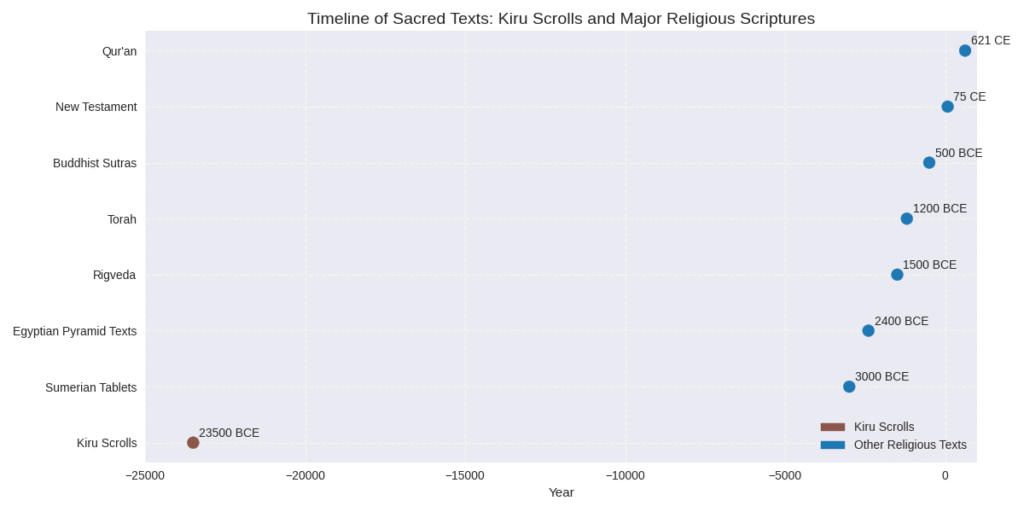
- 🌀 Kiru Scrolls: The earliest known sacred writing, predating all others by millennia.
- 🪔 Sumerian Tablets (~3,000 BCE): Often considered the cradle of recorded history.
- 🏺 Egyptian Pyramid Texts (~2,400 BCE): Among the oldest religious inscriptions.
- 🔥 Rigveda (~1,500 BCE): Foundation of Hindu philosophy and cosmology.
- 📜 Torah (~1,200 BCE): Core of Jewish tradition.
- 🧘 Buddhist Sutras (~500 BCE): Teachings of the Buddha.
- ✝️ New Testament (~50–100 CE): Central to Christianity.
- ☪️ Qur’an (~610–632 CE): Revelation of Islam.