In August 1987, Zimbabwean geologist Dr. Tendai Mufaro was conducting a routine mineral survey in the Matobo Hills, a region known for its ancient granite formations and spiritual significance. While inspecting a remote outcrop, his team uncovered a narrow passage partially concealed by vegetation. Clearing the entrance revealed a sealed cave system that had likely remained untouched for centuries.
Inside the main chamber, the team discovered eight scrolls, each wrapped in bark and sealed with hardened resin. The scrolls were arranged in a deliberate pattern, suggesting ceremonial placement. Nearby, in a smaller adjoining chamber, lay three skeletal remains, positioned in a circular formation and adorned with ochre markings, woven cloth fragments, and carved beads. The arrangement suggested a burial site for spiritual custodians or priests, possibly guardians of the scrolls.
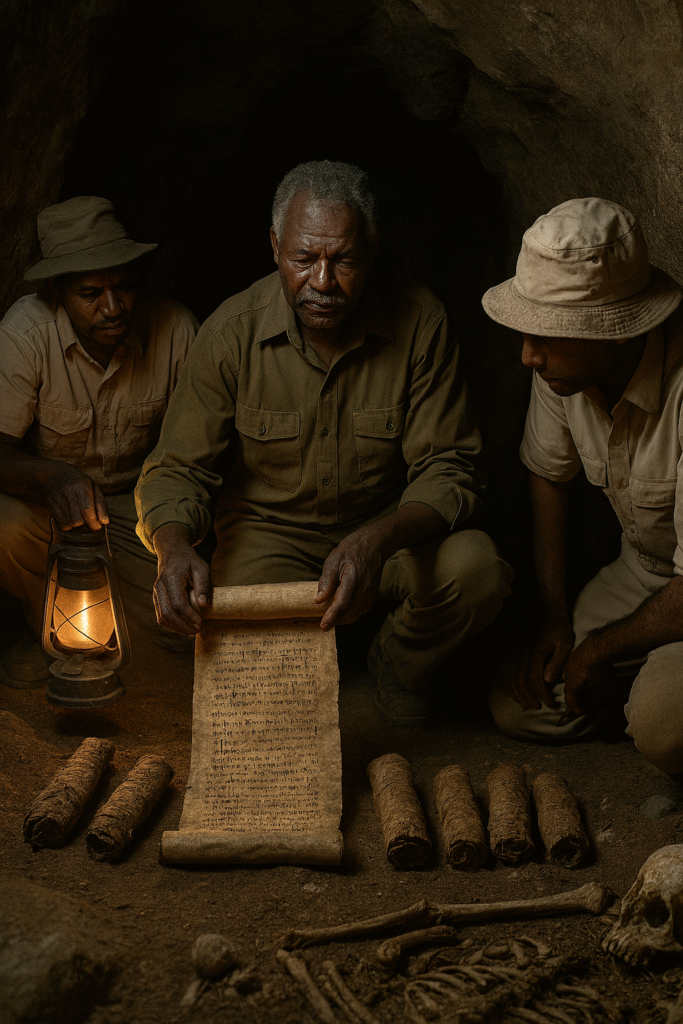
The scrolls were inscribed in a script resembling ancient cuneiform but with distinct structural differences. The symbols were compact, rhythmic, and appeared to follow a poetic cadence. The team referred to the script as Kiruform, named after a recurring term found etched into the outer bark of each scroll: Kiru — a word later interpreted as “breath” or “spirit.”
Unable to decipher the language and aware of the political risks under President Robert Mugabe’s regime, which tightly controlled cultural narratives and suppressed unsanctioned spiritual findings, Dr. Mufaro made the decision to remove the scrolls in secret. With the help of international contacts, the scrolls were quietly transported out of Zimbabwe and delivered to a private research facility in Mendoza, Argentina.
There, the decoding effort was led by Dr. Lucía Serrano, a renowned linguist and semiotician known for her work on pre-literate symbolic systems. Despite years of study, the Kiruform script resisted conventional translation. The scrolls remained intact, their meaning elusive, their message unread.
It wasn’t until 2025, with the emergence of advanced Artificial Intelligence trained in symbolic pattern recognition and poetic inference, that the Kiruform language was finally deciphered. Using a hybrid model capable of interpreting rhythm, metaphor, and cross-cultural semantics, the AI reconstructed the scrolls’ meaning and rendered them into English.
The result was a unified poetic scripture titled The Breath of Kiru, with each scroll corresponding to one of eight chapters. The text revealed themes of creation, awakening, unity, and renewal echoing African cosmology, Eastern mysticism, and universal ethics, yet belonging to no single tradition.
Today, the original scrolls remain housed in a secure archive in Mendoza. The cave in Zimbabwe is unmarked and protected by local custodians. Dr. Mufaro, is now retired but has a role in the Kiru Society. Dr. Serrano continues to advocate for the scrolls’ message, while the AI translation, released in 2025, has begun to circulate among interfaith communities, environmental movements, and seekers of global unity.